There is a moment that happens in almost every organization. Someone walks out of a board meeting, a leadership sync, or a project review, confident that a decision was made. A week later, two colleagues are arguing about what was actually agreed. Emails get forwarded. Slack threads spiral. Someone says "that's not what I heard" and nobody can prove otherwise.
This is not a communication problem. It is a documentation problem. Meeting minutes, done properly, have solved this for centuries. But most modern teams have quietly abandoned them in favor of audio recordings, AI transcripts, and optimistic trust that everyone remembers things the same way.
Why Do Meeting Minutes Still Matter?
Meeting minutes matter because they turn a discussion into a record. Approved minutes show what a group decided, who owns each action, and who confirmed it. Without them, people rely on memory, and memories differ. A transcript or summary cannot settle a dispute. Confirmed minutes can.
A new generation of tools promises to solve the minutes problem with AI. Record the meeting, upload the audio, receive a summary. The appeal is obvious.
AI-generated summaries solve a different problem. They make it easier to produce a document. They do not make it easier to govern. A summary is not a record. A summary has no formal status. A summary cannot be confirmed, approved, or used to show that the people in the room made a specific decision.
AI can accelerate the drafting of minutes, but it cannot replace the governance step. Minutes only become a record when they are reviewed, confirmed, and locked by the people accountable for the meeting.
This distinction matters most for bodies that must keep minutes: company boards, not-for-profit committees, housing associations, pension trustees, and many others. Law, bylaws, or funders often require minutes. The rules differ by jurisdiction and by type of body, so check the rules that apply to yours. An unconfirmed summary has no formal status, so it cannot serve as the approved record.
The Case for Minutes That Nobody Is Making
Ask ten people what meeting minutes are for and you will get ten answers: attendance records, legal protection, compliance box-ticking, onboarding material for people who missed the meeting. All of those answers are correct, but they miss the deeper purpose.
Meeting minutes are accountability infrastructure. They are the mechanism by which decisions become binding, actions become trackable, and organizational memory persists beyond the tenure of any individual. In governance-sensitive contexts (board meetings, AGMs, committee reviews, regulated industries), minutes are not a nice-to-have. They are the formal record of what your organization decided and why.
If it's not written down, it didn't happen. If it's written down inaccurately, what happened is whatever the document says.
A system of record does not care whether the meeting had twelve board directors or three engineers at a standup. It cares about what was decided, who is responsible, and when. The value of meeting minutes scales down just as well as it scales up. A PM tracking commitments from a daily sync needs the same clarity as a board secretary documenting a fiduciary vote.
This matters more than ever in an era of distributed teams. When half your board joins by video call and the other half are in the room, there is no shared ambient experience. The minutes are the one canonical record that everyone, everywhere, can refer to, provided they are captured accurately and promptly.
What Goes Wrong: The Three Failure Modes
Most meeting documentation fails in one of three ways, and each failure has real downstream consequences.
1. Minutes that are never written
The meeting ends, everyone rushes to their next commitment, and the secretary's notes sit in a personal notebook or a local Word document that never gets shared. Decisions evaporate. Action items are forgotten. Months later, the same discussion happens again with the same outcome and the same lack of follow-through.
2. Minutes that are too detailed
At the other extreme, some organizations produce verbatim transcripts: every tangential remark, every digression, every half-finished sentence. The result is a very long document that nobody reads. The actual decisions are buried. The action items require a detective to find. Detailed is not the same as useful.
3. Minutes that go unreviewed
Perhaps the most common failure: minutes that are written, distributed, and then never confirmed. Without a formal review and approval step (typically at the next meeting), minutes remain a draft. A draft is not a record. A draft can be disputed, revised, or quietly ignored. Only confirmed minutes carry governance weight.
What Should Meeting Minutes Include?
Effective meeting minutes are not a transcript. They are a structured summary that captures the essential information a non-attendee would need to understand what happened and what comes next. The key elements are straightforward:
- Date, time, location, and attendees (including apologies)
- Agenda items discussed, with brief context for each
- Decisions reached, stated clearly and unambiguously
- Action items with named owners and due dates
- Any items deferred to a future meeting
- Date and time of next meeting (if agreed)
Notice what is not on that list: everything else. Meeting minutes are not a transcript of debate. They do not need to capture who argued which position or how long the discussion ran. What matters is the outcome, the decision and who is responsible for acting on it.
Worked Example: One Decision, Written Two Ways
Robert's Rules of Order Newly Revised, 12th edition, advises that minutes record what was done, not what was said. The same principle applies to every body. Compare two entries for one decision.
- Weak entry: "Budget discussed. Several concerns raised about the venue cost. Will follow up."
- Strong entry: "Decision: The board approved a venue budget of $4,000 for the spring event. Moved by A. Rivera, seconded by J. Chen. Carried 5 to 1, with 1 abstention. Action: M. Okafor will confirm the venue booking by 14 March."
The weak entry records a topic. The strong entry records a decision, the vote, an owner, and a due date. All names and figures here are invented for illustration. Use this checklist before you confirm any set of minutes:
- Each decision is stated as a decision, in plain words.
- Each motion shows who moved it, who seconded it, and the result.
- Each action item has one named owner and a due date.
- Attendance and apologies match who was in the room.
- Anything said off the record is left out.
- The chair or another accountable person has reviewed and approved the draft.
The 24-Hour Rule
A common practice is to send draft minutes within 24 hours of the meeting. After that, memories fade and context shifts. The longer the wait, the less likely the document is to be produced at all. Speed matters not for perfection, but for relevance.
This is where organizations often struggle. The person who takes the minutes is usually also a participant, often a key one. Writing clear, structured minutes while contributing to the discussion is hard. It is also the point where recording and AI drafting can help most.
What Makes Meeting Minutes Tamper-Evident?
One more property matters after confirmation: the record should be tamper-evident.
Once minutes are confirmed, they should not be silently editable. If a correction is needed, it should go through a formal amendment process: noted at the next meeting, appended to the record, attributable to a person. The integrity of the record depends on one thing: showing that what the document says today is what it said when it was approved.
This is not paranoia. Disputes over corporate decisions, charity governance failures, and employment matters can turn on what a meeting decided and when. A Word document on a shared drive, last modified by an unknown user at 11pm on a Sunday, is weak evidence.
Making It Stick: Turning Good Intentions Into Consistent Practice
The gap between knowing what good minutes look like and consistently producing them is a process gap, not a knowledge gap. Organizations that do this well share a few common traits.
They assign minute-taking responsibility explicitly, before each meeting, not as a last-minute ask to the most junior person in the room. They use a consistent format so that every set of minutes is structured identically and easy to navigate. They treat the review and confirmation step as a standing agenda item, not an afterthought. And they store their records where access is controlled and the history is kept.
The Decision Register
Few organizations take the next step: a decision register. This is a continuously updated record of every significant decision, cross-referenced to the meeting where it was made and who was present. It turns a question like "when did we change the refund policy?" from email archaeology into a quick lookup.
The effort to maintain a decision register is modest. The return is fewer disputes, faster onboarding, cleaner audits, and a stronger accountability culture.
The Bottom Line
Meeting minutes are not a bureaucratic relic. They are the foundation of organizational accountability. When decisions are captured accurately, confirmed promptly, and stored securely, organizations can follow through on them and show what was agreed when questions arise.
The tools available today (audio recording, AI transcription, structured templates) make good meeting documentation much easier. What remains is the process discipline to use those tools to produce a genuine governance record, not just a file that sits in a folder.
This Is What ācta Was Built For
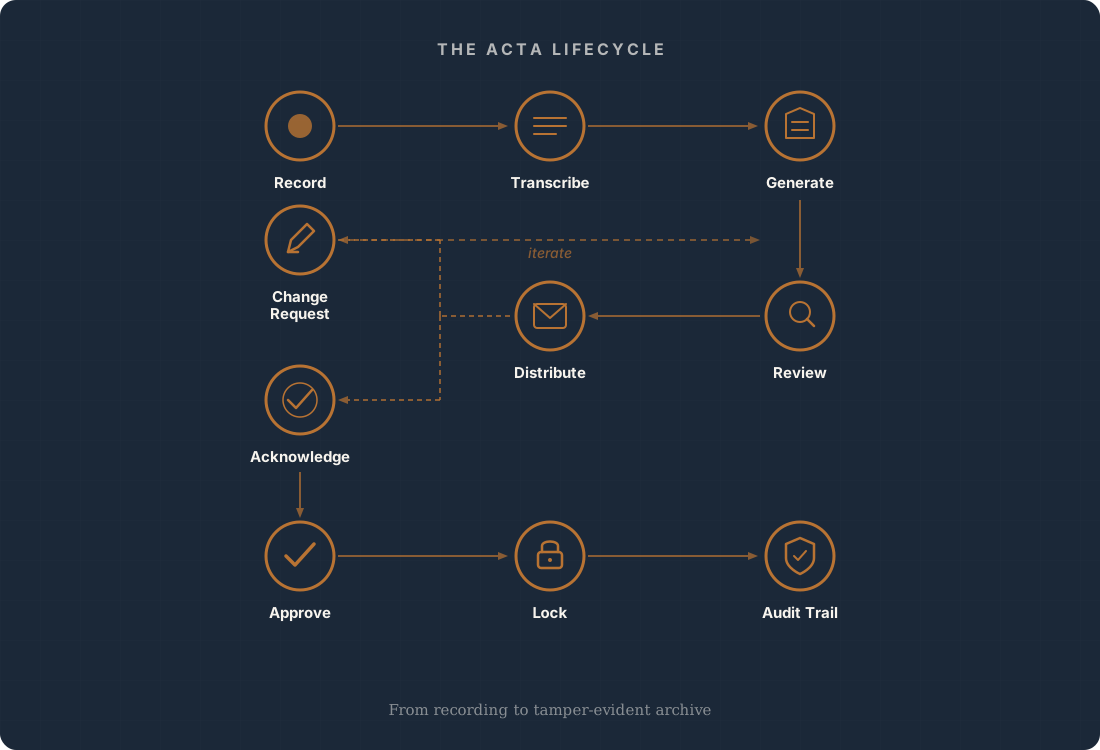
ācta is designed around this complete loop. You record the meeting in ācta. No bot joins the call. From the recording, ācta drafts structured minutes: decisions, action items, and attendance. Segments marked off the record are removed before AI processing. The chair reviews the draft, makes corrections, and approves it. At approval, ācta computes a SHA-256 hash and seals it into the record. Any later change to the document breaks the hash chain, so tampering is detectable.
Approved minutes are exported as hash-sealed PDFs that carry the full approval history. Distribution goes out from one screen, and recipients acknowledge receipt through a secure link without creating an account. Every decision flows into a cross-meeting register, so the question "when did we change that policy?" becomes a quick lookup. Approvals and changes to minutes go into a tamper-evident audit trail. Anyone with an account in the workspace can check a PDF or hash against its sealed records, and external auditors verify in an audit session.
The question is not "do we write minutes?" It is "could we prove exactly what was decided, by whom, and who owns it?"
If the answer is not an immediate yes, review how you manage your meeting record. A record that cannot show what was decided, by whom, and who owns it is not yet doing the job of minutes.
Sources
- Robert's Rules of Order Newly Revised, 12th edition: Frequently Asked Questions (citing §48:2, §48:4(5), §48:15). Robert's Rules Association, October 6, 2026.